


WE'RE EXPERTS IN PHYSIOTHERAPY, MASSAGE THERAPY AND REHAB
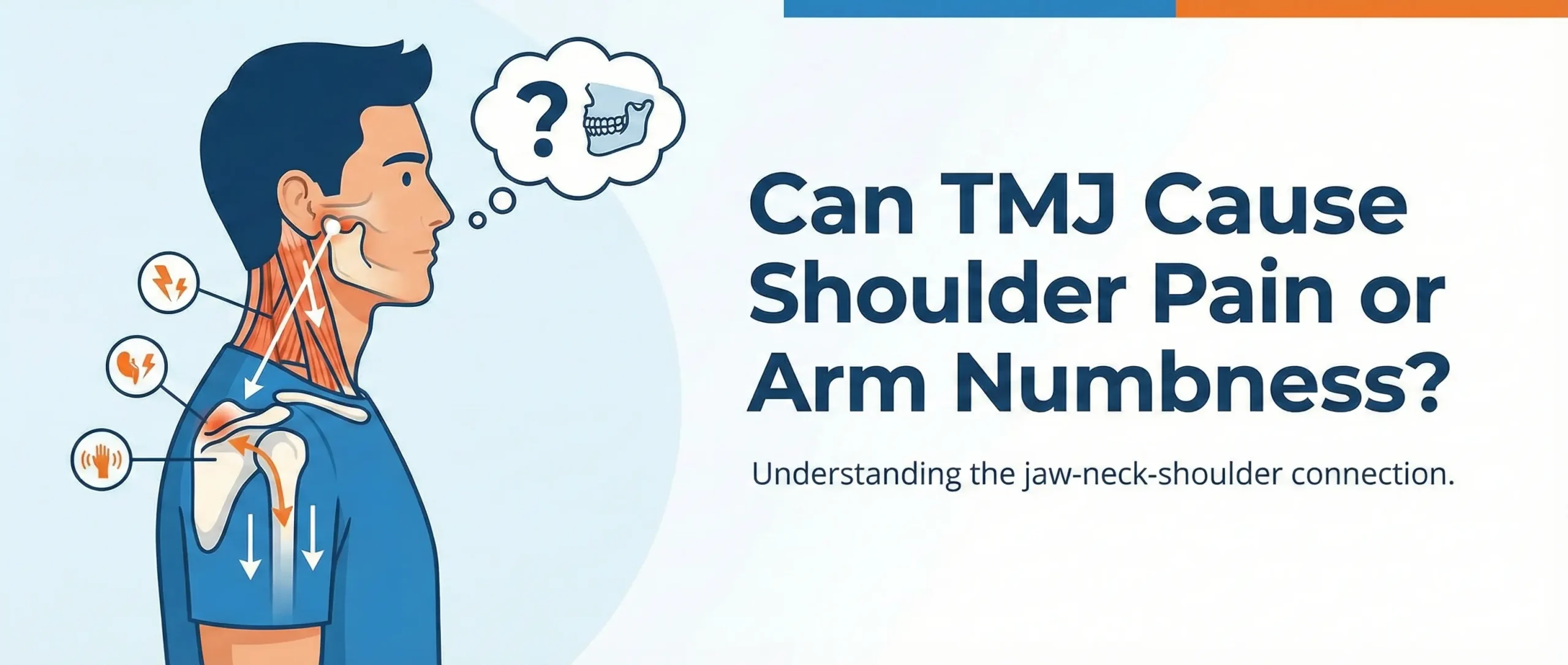
Many people are surprised to learn that jaw problems can affect areas far beyond the face. If you’ve been struggling with jaw clicking, headaches, neck stiffness, and unexplained shoulder pain or arm tingling, you might be asking an important question: Can TMJ cause shoulder pain or arm numbness?
The short answer is yes—TMJ Cause Shoulder Pain and even nerve-like symptoms in the arm due to muscular tension, postural changes, and nerve irritation.
At Motion Focus & Sports Clinic, we frequently treat patients who come in for shoulder or neck discomfort, only to discover that the root cause begins with the jaw.
Let’s explore how this connection works—and what you can do about it.
TMJ stands for the temporomandibular joint—the hinge that connects your jawbone to your skull. You have one on each side of your face, just in front of your ears.
This joint allows you to:
When this joint becomes irritated, misaligned, inflamed, or dysfunctional, it leads to Temporomandibular Joint Disorder (TMD).
But what many people don’t realize is that TMJ issues don’t stop at the jaw.
Yes. TMJ Cause Shoulder Pain through a chain reaction in the body.
Here’s how:
Your jaw muscles are connected to your neck muscles. Your neck muscles connect to your shoulders. This interconnected system is often referred to as the myofascial chain.
Over time, this leads to:
At Motion Focus & Sports Clinic, we often see patients treated repeatedly for shoulder pain—without lasting relief—because the jaw was never evaluated.
TMJ dysfunction frequently causes subtle changes in head alignment.
When your jaw isn’t aligned properly:
This condition, often associated with “tech neck,” increases strain on:
That extra strain can absolutely explain persistent shoulder discomfort.
While less common than shoulder pain, arm numbness can occur indirectly due to TMJ-related tension.
Here’s why.
Muscles around the jaw and neck sit close to major nerve pathways, including:
When neck muscles tighten from TMJ dysfunction, they may:
Patients sometimes describe:
If cervical nerve compression is involved, TMJ may be a contributing factor rather than the sole cause.
Pain doesn’t always stay where it starts.
Trigger points in jaw and neck muscles can refer pain to:
This can feel like:
Without proper assessment, the real source can be missed.
Many patients:
But the jaw is rarely examined.
At Motion Focus & Sports Clinic, we take a full-body biomechanical approach. Instead of isolating the painful area, we evaluate:
This comprehensive method helps identify whether TMJ Cause Shoulder Pain in your case.
You might have a TMJ connection if you notice:
If jaw movement increases or reduces your shoulder symptoms—that’s a major clue.
At Motion Focus & Sports Clinic, we focus on long-term correction—not temporary relief.
Our TMJ and shoulder rehabilitation program includes:
We address the root cause—not just the symptom.
Seek evaluation if you experience:
Early intervention prevents chronic compensation patterns.
Mild cases may improve with:
However, chronic cases typically require structured therapy. Ignoring the issue can lead to:
At Motion Focus & Sports Clinic, we specialize in:
We don’t treat symptoms in isolation. We treat movement patterns.
If you’re wondering whether TMJ Cause Shoulder Pain in your case, our team will provide a detailed assessment and personalized recovery plan.
So, can TMJ cause shoulder pain or arm numbness?
Yes—through muscle tension, postural imbalance, and nerve irritation. The jaw, neck, and shoulders work as a system. When one part fails, the others compensate. If you’ve been treating shoulder pain without results, it might be time to look at your jaw.
Call +1 (403) 375-7676 to book a consultation at Motion Focus & Sports Clinic today and discover the real source of your discomfort. You can also contact us at NW Calgary, AB.
Your recovery starts with the right diagnosis.
Yes. TMJ dysfunction often affects one side more than the other, leading to unilateral shoulder tightness or pain.
It can contribute indirectly, especially if poor posture or neck compression worsens while sleeping.
With proper physiotherapy, many patients improve within 4–8 weeks, depending on severity.
No. With correct diagnosis and rehabilitation, most cases are reversible.
Both can help. Dentists address bite alignment, while physiotherapists address muscular and postural contributions. At Motion Focus & Sports Clinic, we focus on musculoskeletal correction.